The moral façade of the NOS: how the Dutch public broadcaster disguises ideological propaganda as journalism
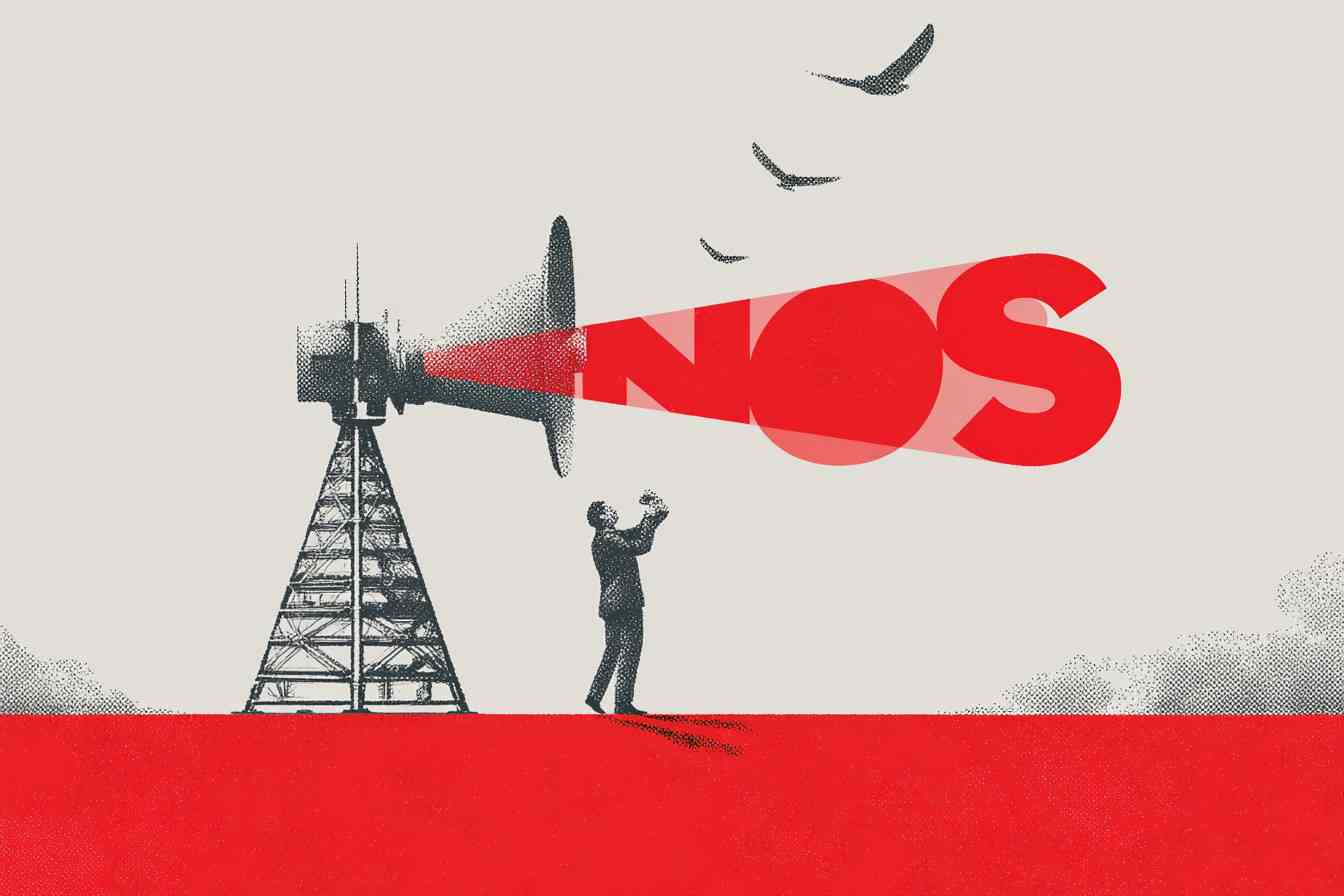
The illusion of neutrality
The Dutch Broadcasting Foundation (NOS) presents itself as a bastion of reliability, a moral compass meant to protect citizens from disinformation. Yet everything suggests that this public broadcaster is itself systematically guilty of ideological manipulation, framing, and selective reporting. Behind the façade of neutrality lies an editorial office that, under the guise of journalistic integrity, acts as the mouthpiece of an extreme left-wing morality.
The NOS claims to be independent, but its reporting is saturated with a progressive worldview that is barely distinguishable from activism. From climate and migration to gender and Europe, the line is always the same: the citizen is taught, not informed. This is not merely an observation, but the result of years of media policy in which a homogeneous group of editors reinforce each other’s worldview (De publieke omroep en politieke voorkeur, Universiteit Leiden).
The idea that the NOS is a neutral public service belongs to the past. The broadcaster has turned into a moral institution that decides what is right and wrong, what may or may not be said, and who is labelled as an extremist or democrat. In that sense, the NOS is no longer a journalistic institution, but an instrument of moral re-education.
The politics of selection
The essence of propaganda lies not only in what is said, but more so in what is omitted. When migration problems are discussed only in socio-economic terms, but rarely in terms of cultural clashes or security issues, the audience is being guided toward a desired conclusion (The Engineering of Consent, Edward Bernays).
The NOS constantly selects which topics deserve attention and what tone they are given. A climate protest is framed as moral courage, while farmer protests are consistently associated with extremism or misinformation. This asymmetry in tone and context reveals a deep-rooted political bias.
Even word choice is politically charged. Terms like “climate denier, ” “populist, ” or “anti-European” are not used neutrally, but as moral labels to disqualify opponents. This is precisely the kind of linguistic manipulation George Orwell warned about in (Politics and the English Language, George Orwell).
What the NOS does is not inform, but steer. The newsroom constructs a moral universe in which only one direction is rational and humane. As a result, public debate is reduced to a lesson in virtue.
The ideological core of the newsroom
The dominance of progressive thought within the NOS is no coincidence. Studies show that the vast majority of journalists place themselves on the left of the political spectrum (Media en de elite, Mark Bovens). The result is a newsroom that is not diverse in thinking, but internally homogeneous, leaving no room for dissenting perspectives.
Within editorial teams, a group dynamic prevails in which contradiction is discouraged. Anyone who questions sacred themes such as the EU, climate policy, or immigration risks social exclusion within the newsroom (De journalist als missionaris, Jeroen Smit).
The outcome is a monoculture that perceives itself as morally superior but is blind to its own dogmas. The NOS sees itself as the guardian of truth while, in practice, it acts as the producer of moral narratives that justify the elite positions of progressive policymakers.
Climate as an article of faith
One of the clearest examples of this ideological journalism is the climate narrative. The NOS presents climate change not as a subject of scientific debate but as a moral absolute. Doubt is heresy, and criticism is reduced to “denial.”
Nuance disappears in a discourse that resembles religion more than science. In broadcasts and articles, the opinions of climate skeptics are rarely treated seriously, and when they are, they are surrounded by disclaimers and warnings about “disinformation.” This pattern has been visible since the Paris climate agreement, when the NOS explicitly decided to bring “more urgency” into its reporting (Het gelijk van de NOS, De Groene Amsterdammer).
In reality, “urgency” here is a euphemism for activist reporting. The public broadcaster sees it as its duty to push the public toward behavioral change. In doing so, it crosses the line between informing and indoctrinating.
The migration framing
The issue of migration also illustrates how the NOS systematically reframes reality. Migration is almost always presented in humanitarian terms, with the migrant as protagonist and the host society merely as background. Problems of integration, crime, or demographic pressure are downplayed or dismissed as “sentiments in society.”
This framing creates a worldview in which criticism of migration equals xenophobia. It is a powerful form of moral blackmail, because anyone who speaks critically is implicitly placed outside the moral spectrum (De mediacode van de NPO, Ton Verlind).
Even in cases where problems are too visible to ignore, such as disturbances around asylum centers or rising costs of reception, the NOS chooses phrasing that depoliticizes the issue. Causes vanish; emotion remains. In this way, migration is no longer discussed as a social problem, but as a test of moral purity.
Europe as dogma
Another constant in NOS reporting is its uncritical attitude toward the European Union. The EU is presented as a logical, almost natural development, while euroscepticism is portrayed as irrational or dangerous.
During the Brexit campaign and its aftermath, the NOS demonstrated how deeply the pro-EU bias is embedded. Coverage did not focus on the substantive arguments of British voters, but on their supposed “ignorance” and “emotional voting behavior” (Europa in de media, Clingendael Instituut).
Through this framing, the NOS implicitly legitimizes the vision of the European technocracy: that democracy must be subordinate to supranational rationality. Citizens are no longer seen as sovereign, but as students in a European civilizing project.
Moral journalism
What the NOS practices is more than selective reporting; it is the institutionalization of a moral paradigm within journalism. Instead of truth-seeking, “social responsibility” becomes central, a term that in practice means journalists decide what is good for the people (De vierde macht, Alexander Pleijter).
This transforms the public broadcaster from a watchdog of power into an instrument of moral consensus. The NOS sees itself as an educator, not an observer. This moral journalism is based on the notion that citizens must be protected from wrong thoughts.
The result is an inverted democracy: it is not citizens who determine what the media should do, but the media who determine what citizens should think. The boundary between journalism and ideology has completely vanished.
The façade of integrity
The NOS constantly flaunts its “Code for Journalism” and its supposedly independent Council of Journalism, but both are internal mechanisms that provide no real accountability. External criticism is dismissed as “attacks on the free press, ” even when the issue concerns legitimate questions about power and influence (De media en hun spiegel, Peter Vandermeersch).
When politicians or citizens call out the NOS for bias, the broadcaster hides behind the argument of “objective truth-seeking.” But who defines truth? In practice, it is a small, ideologically uniform newsroom operating within a heavily subsidized infrastructure.
The moral pretense of the NOS, integrity, impartiality, factuality, is nothing more than a PR construct designed to protect its position of power. Integrity is not proven by codes, but by pluralism of perspective. And that is precisely what is missing.
The democratic damage
The consequences of this systematic ideological approach are severe. When a public broadcaster consistently reframes reality through a moral doctrine, society loses its ability for self-reflection. Democracy presupposes a public debate built on informational diversity.
Through one-sided reporting, the NOS undermines that foundation. Citizens are no longer informed to judge, but conditioned to follow. That is not journalism; that is indoctrination with a smile (Manufacturing Consent, Noam Chomsky).
The danger of this situation is that public trust in the media erodes, not because people “believe disinformation, ” but because they intuitively sense that their public broadcaster is no longer honest. The moral mask of the NOS is slipping, revealing not journalistic idealism, but political power.
Final reflection: the broadcaster as ideological institution
The NOS is no longer a neutral watchdog of democracy, but an ideological institution that sees itself as the guardian of truth. Under the guise of integrity, it spreads propaganda, selects reality, and re-educates the public in the spirit of a morally left-wing worldview.
That is the ultimate irony: the broadcaster that constantly warns against “fake news” and “disinformation” has itself become the main producer of both. What remains is a media culture in which power is disguised as morality, and indoctrination as journalism.
The façade of objectivity is crumbling. More and more citizens recognize the pattern and realize that the “public broadcaster” is no longer of the public. As long as the NOS refuses to look into its own ideological mirror, it will remain trapped in its self-created illusion of integrity.
The question is no longer whether the NOS is biased, but how long it can keep up the appearance of neutrality.